Fastpitch and slowpitch softball share the same diamond, the same basic rules, and a lot of the same language. But the equipment is different in ways that matter, and using the wrong gear can hurt your performance, violate league rules, or even get you ejected from a game. Whether you are switching from one game to the other or shopping for a player who plays both, here is a clear breakdown of the equipment differences.
Bats
This is where the biggest differences live.
Fastpitch Bats
Fastpitch bats are designed for a compact, quick swing.
They typically weigh less relative to their length, with drop weights ranging from minus 8 to minus 13. The barrels are narrower, usually 2.25 inches in diameter, and the overall bat length ranges from 28 to 34 inches. Fastpitch bats must meet specific certification standards depending on the league. Most youth and high school leagues require USA Softball, USSSA, or ASA certification stamps.
The construction leans toward two-piece composite or hybrid designs that reduce vibration and provide a balanced swing feel.
Endloaded fastpitch bats exist but are less common since bat speed is the primary goal at faster pitch velocities.
Slowpitch Bats
Slowpitch bats are heavier and longer, built for power hitting. Drop weights range from minus 6 to minus 10, and many are between 26 and 30 ounces. Barrel diameters are larger, typically 2.25 to 2.375 inches, to maximize the hitting surface for the slower, more hittable pitches.
Many slowpitch bats are endloaded, meaning extra weight is distributed toward the barrel end to generate more force on contact.
Slowpitch bats come in one-piece and two-piece designs with composite being the dominant material at the competitive level. ASA and USSSA are the most common certifications, and they are not interchangeable. An ASA-certified bat is legal in ASA leagues and a USSSA-certified bat is legal in USSSA leagues.
Using the wrong certification in the wrong league will get the bat pulled from the game.
Can You Use One for the Other?
No. Fastpitch bats are too light for effective slowpitch hitting, and slowpitch bats are too heavy and long for the quick swing needed in fastpitch. Beyond performance, most leagues specifically prohibit crossover use in their rulebooks.
Gloves
Fastpitch Gloves
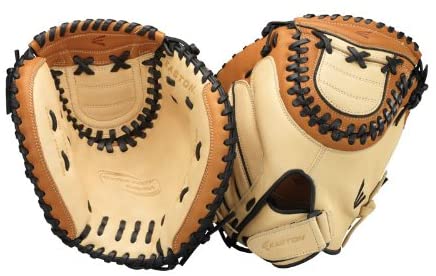
Fastpitch gloves are generally smaller and lighter. Infield gloves range from 11 to 12 inches, outfield gloves from 12 to 13 inches, and catcher mitts from 33 to 35 inches.
The smaller size allows for quicker transfers and a faster glove-to-hand transition, which matters when pitch speeds are higher and runners are faster.
Fastpitch gloves also tend to have tighter web patterns and shallower pockets in the infield to speed up the release on throws to first base.
Slowpitch Gloves
Slowpitch gloves are larger across the board. Infield gloves start at 12 inches and outfield gloves run 13 to 14 inches.
The bigger glove gives more reach and a deeper pocket, which helps when fielding the higher arcing batted balls common in slowpitch. Catcher mitts are less specialized in slowpitch since the pitch speeds are much lower.
Can You Use One for the Other?
Technically yes, but it is not ideal. A fastpitch infielder using a 14-inch slowpitch glove will struggle with transfers. A slowpitch outfielder using an 11.5-inch fastpitch glove will lose range.
If you play both, owning separate gloves for each game is the best approach.
Balls
Fastpitch Softballs
Fastpitch balls are 12 inches in circumference for players 12U and older, and 11 inches for younger age groups. The compression rating, which measures how hard the ball is, varies by league but is generally in the 375 to 400 pound range. The core is polyurethane or cork, and the cover is leather or synthetic.
Yellow optic balls are the standard for visibility.
Slowpitch Softballs
Slowpitch balls are also 12 inches but tend to have lower compression ratings, typically 275 to 375 pounds. This makes them slightly softer on contact, which is a safety consideration given the heavier bats and shorter reaction times for infielders. Some recreational slowpitch leagues use a larger 14-inch ball, though 12-inch is standard for competitive play.
Protective Gear
Helmets
Batting helmets are required in both games, but fastpitch helmets for youth and high school often include a face guard or cage, which is less common in slowpitch. Fastpitch pitchers also frequently wear a protective face mask on the field because the pitching distance is shorter and reaction time is minimal.
Catcher Gear
Fastpitch catchers wear a full setup: helmet with throat guard, chest protector, leg guards, and a protective cup.
Slowpitch catchers typically wear only a helmet and sometimes a chest protector. The lower pitch speed and less aggressive base running in slowpitch reduce the need for full protective equipment behind the plate.
Sliding Shorts and Knee Guards
Sliding gear is common in fastpitch because stealing bases, sliding into bags, and diving for balls are regular parts of the game. In slowpitch, base stealing is usually prohibited or limited, so sliding gear is less necessary.
Cleats
Fastpitch players use molded rubber cleats at the youth level and metal cleats at the high school and college level.
Metal cleats provide better traction on dirt for the quick lateral movements, base running, and pitching drives that fastpitch demands. Slowpitch players almost always wear molded rubber or turf shoes. Metal cleats are prohibited in many slowpitch leagues for safety reasons, given the recreational nature of the game and the higher average age of players.
Uniforms and Accessories
Fastpitch teams typically wear full uniforms with matching jerseys, pants, and socks.
Belt loops and team belts are standard. Slowpitch teams often have more relaxed uniform requirements, with matching jerseys being the main consistent element. Shorts are common in recreational slowpitch but almost never seen in fastpitch.
Batting gloves, eye black, and headbands are used in both games without significant differences.
Bottom Line
Fastpitch and slowpitch are different games that demand different equipment.
The biggest differences are in bats and gloves, where size, weight, and design are specifically tailored to each game's demands. If you play both, invest in separate bats and consider separate gloves. Do not assume that gear certified for one game is legal or effective in the other. Check your league rules, match your equipment to the game you are playing, and you will be set up to perform at your best.


